
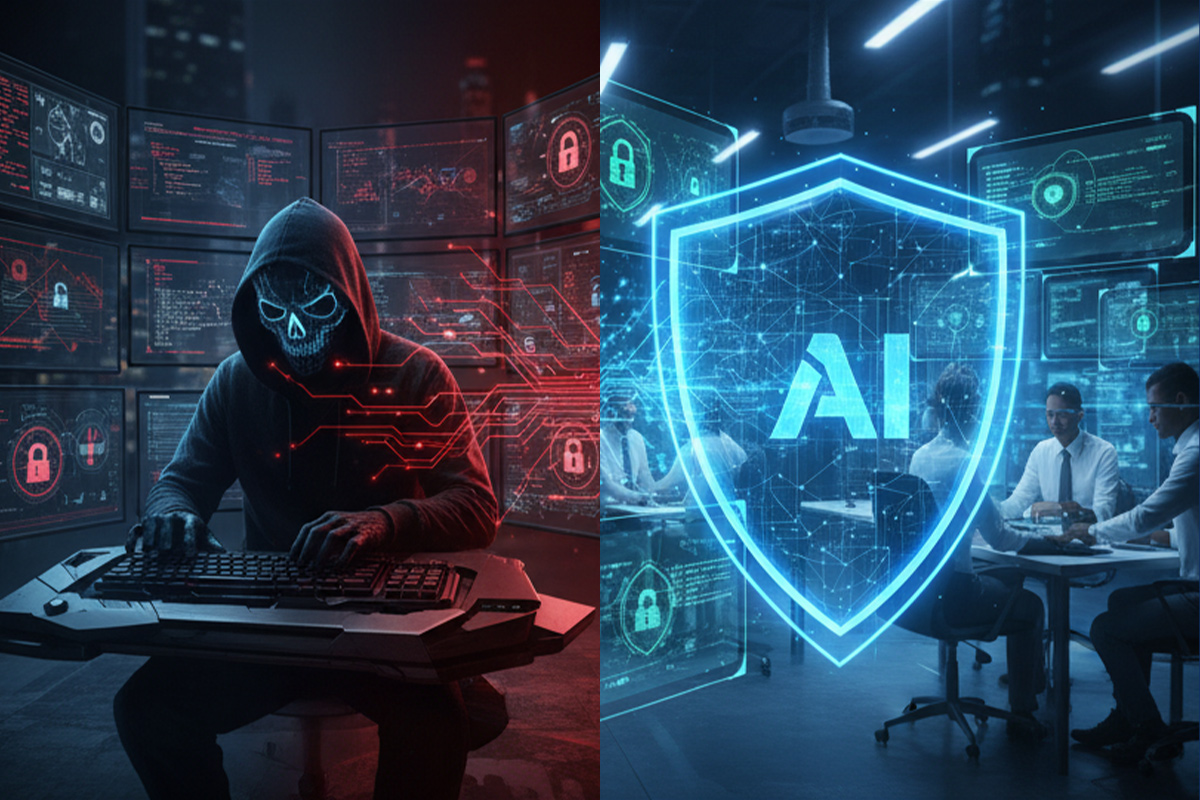
Artificial intelligence has become a double-edged sword in cybersecurity. While businesses use AI to strengthen defenses, cybercriminals also leverage the technology to scale attacks faster and more effectively. Europol’s 2024 Internet Organised Crime Threat Assessment highlighted how generative AI tools are enabling “a new wave of scalable, personalized cybercrime” (Europol, 2024).
How Hackers Exploit AI
Deepfake Phishing
Attackers use AI-generated voice or video to impersonate executives. For example, CFOs have received urgent deepfake calls “from the CEO” instructing them to transfer funds. These schemes are far more convincing than traditional phishing emails.
Password Cracking
Machine learning models can predict common patterns and speed up brute-force attempts. What once took weeks can now be accomplished in hours.
Adaptive Malware
AI-powered malware can change its code in real time to avoid signature-based detection systems. This makes traditional antivirus tools less effective.
Automated Social Engineering
Language models craft highly personalized phishing messages that mimic the tone and style of trusted colleagues.
AI in Defense
Fortunately, AI is also a powerful tool on the defense side:
-
Intrusion Detection Systems (IDS): Machine learning models monitor traffic and flag anomalies in milliseconds.
-
Fraud Detection: Financial institutions use AI to catch suspicious activity. According to the World Economic Forum, banks report up to a 30% reduction in fraud losses with AI-driven systems (WEF, 2024).
-
Behavioral Biometrics: Instead of relying only on passwords, systems analyze typing rhythm, mouse movement, or smartphone usage patterns to identify fraud.
-
Threat Intelligence Platforms: AI scans vast amounts of data to predict attack trends before they hit.
Case Study: Banking Sector Defense
A European bank used anomaly detection to stop a €1 million fraudulent wire transfer. The AI flagged unusual login timing and a mismatch between user location and device, preventing the transfer before funds left the account.
Challenges and Limitations
While AI strengthens defense, it also introduces new challenges:
-
False positives can overwhelm IT teams if models are poorly tuned.
-
Adversarial attacks—hackers attempt to manipulate AI models by feeding them misleading data.
-
Regulatory pressure requires explainable AI so decisions can be audited.
Best Practices for Businesses
-
Adopt AI cybersecurity solutions but combine them with human expertise.
-
Train employees to recognize deepfakes and AI-generated phishing.
-
Continuously update defenses—AI-driven threats evolve quickly.
-
Collaborate with regulators and industry peers to share threat intelligence.
Takeaway
AI has raised the stakes in cybersecurity. To fight AI-driven attacks, businesses must fight fire with fire—deploying AI-driven defenses while ensuring governance and human oversight. Those who delay risk being outpaced by criminals who already embrace these tools.